Honors Admissions Pathways
The Honors College is an academic program at Frederick Community College (FCC) that
is open to students who want more out of their learning and demonstrate the potential
to produce high-quality academic work. There are four pathways into the program:
- Grade Point Average: 3.5 unweighted in high school or college.
- Test Scores: Students automatically qualify with the following test scores:
- SAT: 1100 overall with at least 550 on Reading
- ACT: Reading 24+
- FCC Placement Exams: Honors-level reading (268) and proficient college-level writing
- Open Campus/Dual Enrollment: Students in high school or home school with a 3.5 grade point average (unweighted)
are welcome to get started with college and decide if honors is right for them.
- Provisional: Students who want to try honors and have a compelling case (e.g., started college
poorly but recent performance is strong) can apply to the Honors Coordinator for provisional
status to prove they can do honors caliber work.
Honors Application
To apply, complete the Honors College Application.
The final step is to meet with the Honors Coordinator to identify your goal and FCC
pathway, select honors opportunities, and to create a personalized honors plan for
goal completion.
Membership Responsibilities
Honors students are expected to pursue academic excellence, update their honors plan
each semester, and be engaged in the honors program, FCC, and the community.
To remain in good standing in the Honors College program, students are expected to
maintain a minimum grade point average of 3.0 or higher. Any student whose grade point
average drops below 3.0 will be placed on probationary status and must meet with the
Honors Coordinator for honors advising. The goal is to improve academic performance
and remain in the program.
Honors Learning Overview
FCC Honors is all about striving for excellence. Students in the Honors Program are
active participants in class and are expected to apply what they learn to their local
and global communities.
The Honors College provides next-level learning experiences for students in order
to help them grow. Honors classes pique students’ intellectual curiosity through active
learning techniques, and class discussion is expected.
Honors classes also introduce students to the exciting realm of scholarly research,
which serves as the anchor to the Honors experience. By learning to interpret, generate,
and apply knowledge, Honors students gain a deeper, broader, and more complex understanding.
Students demonstrate their knowledge by completing an Honors project, which is presented
during the Honors Forum, a mini academic conference experience, at the end of each
semester.
Hallmarks of successful Honors projects include:
- Original student creative work or research from primary and secondary sources
- Contextualization of the topic within scholarly context
- Critical analysis that is logical and considers multiple perspectives and evidence
- An articulate thesis and conclusion
- Effective communication (written and oral) of the findings
Successfully implemented, per the Honors Project Rubric, these hallmarks distinguish
a student’s work from only meeting general education standards.
Students who demonstrate superior performance on their projects may be considered
as presenters for local and regional student honors conferences.
Honors Learning Options
The Honors Process
To earn honors credit at FCC – whether by an honors class, honors contract, or honors
independent study – a student must complete an honors project (contextualized within
the scholarship), write a project abstract, and present the project findings at an
Honors Forum. Faculty use the honors project rubric to evaluate each honors project
and submit the rubric to the honors coordinator at the end of the term.
Honors Courses
Honors courses engage in active learning beyond the honors project. Capped at 15 students,
honors courses rely on student-student and student-faculty interaction and participation.
Learning activities vary, but can include class discussion, role-playing, speakers,
field trips, workshops, and so forth. All honors courses stress excellence in reading,
writing, critical thinking, and research.
- HONR 101 – highly recommend because the course provides a great foundation for college and
builds skills for success. We also have Honors Peer Mentors (2nd year students) who
are available to assist new students and welcome you to the honors community. HONR
101 is a Gen Ed Elective that fits into many degree plans.
- HONR 102 – provides support for students doing an honors contract for the first time.
- Gen Ed Requirements – students can complete all their General Education requirements through honors classes,
which are easily transferable.
Honors courses at FCC are easily transferable because they have the same core learning
outcomes and content requirements as the non-honors sections. The difference lies
in how the honors courses are taught and the assignments. Students can complete all
General Education and cultural competency requirements through honors.
Honors Contracts
Honors Contracts can be arranged for courses not in the honors schedule (e.g., MATH
185 Calculus I). The required honors project is additional work to the course requirements
and does not affect the course grade. The honors project can be creative work, research,
or applied learning and must produce a final deliverable (e.g., artwork, research
paper), abstract, and an Honors Forum presentation. Remember to contextualize your
project within the scholarly literature on the topic. The faculty mentor will use
the honors project rubric to assess whether the project meets honors standards and
merits honors credit. Contact the honors coordinator to request an honors faculty
mentor.
- Honors Contract Application
Honors Independent Study
Students can conduct scholarly research or produce creative works through Honors Independent
Study projects under the supervision of a faculty mentor. Usually reserved for second-year
students who have completed an introductory course in the discipline of study, these
projects are an opportunity to delve deeper into a topic of interest or explore a
potential major.
Honors Forum
The Forum is styled as a mini-conference, and is open to the public. Student presenters
should dress and conduct themselves professionally. Using an executive summary approach
based on the project abstract, students may opt for an individual or panel oral presentation
(8-10 minutes preferably with slides) or a poster presentation. Honors faculty members
serve as session moderators and collect each presenter's project abstract. Students
with outstanding projects and presentations may be encouraged to submit a proposal
to present at a conference.
Graduation
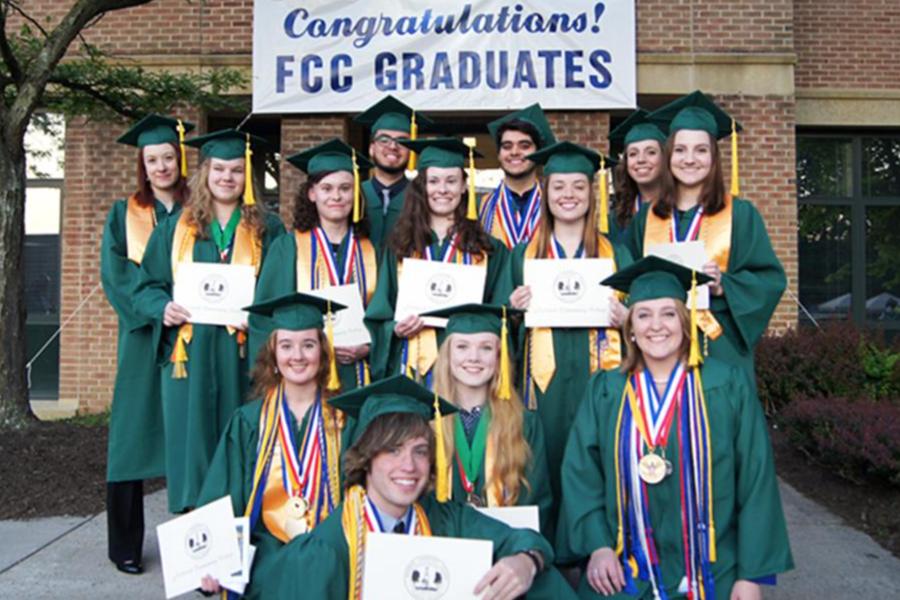
Students who complete 12 honors credits with an overall grade point average (GPA)
of 3.250 or higher are eligible to graduate from the Honors College. Graduates receive
a notation on their transcripts recognizing this achievement. Further, at the graduation
ceremony they wear an Honors College medallion. The transcript notation and color
of the medallion are based on the student’s grade point average at the time of graduation:
| GPA |
Transcript Notation |
Medallion |
| 3.250 - 3.499 |
Honors College |
Bronze |
| 3.500 - 3.749 |
Honors College – Honors |
Silver |
| 3.750 - 4.000 |
Honors College – High Honors |
Gold |
Academic Awards & Recognitions
Anne Slater Honors Excellence Award
Anne Slater was an award winning honors coordinator and faculty member known for her
exacting standards. With Anne’s blessing, the Honors College established this award
to recognize students who demonstrated excellence in their honors research/applied
learning projects during the academic year.
Portz Award Nomination
The Maryland Collegiate Honors Council (MCHC) annually sponsors the John & Edythe
Portz Award for the outstanding honors student in the State. Since 2019, three FCC
students have been named as co-winner or winner.
Honors Conferences
Maryland Collegiate Honors Council (MCHC)
The annual state honors conference, sponsored by the Maryland Collegiate Honors Council
(MCHC), showcases student research through presentations and posters. If interested,
work with your honors faculty mentor to connect your project abstract into a proposal
that addresses the conference theme. Submit to the Honors Coordinator for consideration,
selected proposals will be submitted in early December, the MCHC conference is typically
held the first Friday/Saturday in March.
Northeast Regional Honors Council (NRHC)
Held in early April, the Northeast Regional Honors Council (NRHC) conference includes
students from two- and four-year colleges from Maryland to Maine. Participation is
even more competitive and prestigious. The proposal deadline is usually from early
to mid-November. Contact the Honors Coordinator earlier to review your project.
Leadership Opportunities
Contact the Honors Coordinator to apply.
Honors Peer Mentor
Being a peer mentor is a great way to practice student leadership. Students enrolled
in HONR 201 qualify for both the leadership certificate and the service certificate.
Responsibilities include being a resource to Honor 101 or first year honors students,
assisting or co-leading learning activities, and serving as a role model for honors
learning.
Honors Student Association
The Honors Student Association (HSA) is a recognized student club at FCC and is open
to all students. There is a constitution on file with the Student Government Association
and an officer with the club serves as liaison with SGA and attends the scheduled
meetings. As required, HSA completes a budget request, submits meeting minutes, and
completes a service project for each semester. The scheduled monthly meetings as well
as planning meetings for events are announced via emails and on the white board in
the Honors Lounge (H-247), which serves as headquarters for HSA and accessed by numerous
students each semester.
Honors Advisory Board, Student Representative
At a minimum, one Honors Student Association (HSA) officer and one student at-large
will serve annually on the Board. The FCC Honors Coordinator will nominate students
for these positions. Students may serve two 1-year terms.
Phi Theta Kappa
Phi Theta Kappa (PTK) is an international honors society that recognizes the academic
achievement of two-year college students and provides opportunities for its members
to grow as scholars and leaders.
By completing 12 credits with a 3.50 cumulative grade point average at Frederick Community
College, students are eligible to join the Alpha Delta Sigma chapter of PTK. EDGE
training, leadership, and research can bolster chances to earn scholarships through
PTK.
Phi Theta Kappa (PTK) FAQs
- What is Phi Theta Kappa?
- Phi Theta Kappa (PTK) recognizes the academic achievement of two-year college students
and provides opportunities for its members to grow as scholars and leaders. Established
in 1918, Phi Theta Kappa (PTK) has a presence on almost 1,300 community college campuses
in 11 nations. The American Association of Community Colleges (AACC) recognized Phi
Theta Kappa as the official honor society for two-year colleges in 1929.
- The Middle States Region (MSR) of Phi Theta Kappa serves over 75 chapters throughout
the states of Delaware, Maryland, New Jersey, Pennsylvania, and the District of Columbia.
- How do I become a member?
- To join, you must receive an invitation from your college's Phi Theta Kappa chapter.
The local chapter determines eligibility, and requirements can vary by chapter.
- Be enrolled in an institution that has a Phi Theta Kappa chapter.
- Have completed at least 12 hours of coursework toward an associate or bachelor’s degree
or at least 6 hours of coursework toward a 1-year certificate.
- Have a cumulative 3.5 grade point average
- The only requirement will be to maintain your GPA to the chapter's maintenance GPA
standards.
- What are the benefits of joining?
- PTK Edge Programs: are professional development and leadership courses that are taken at your own pace.
The PTK Edge programs were specifically developed to create an accessible way for
members to get specialized, in-depth skills and knowledge in a range of areas to help
with academic success, transfer readiness, and workforce preparation – Healthcare
Edge, Transfer Edge, Research Edge, Competitive Edge, and Employment Edge. Successful
completion of each Edge lets you download a digital badge showing your achievement
and is an excellent addition to your resume and social media profiles.
- PTK Connect: is a tool for college transfer and scholarship searches. PTK Connect allows you to
search for thousands of colleges and universities, especially those that offer scholarships
just for being a PTK member. These can range from hundreds to thousands of dollars.
Phi Theta Kappa also offers twice-yearly competitive scholarships based on your academic
goals. These scholarships provide substantial financial support to help students achieve
their educational goals.
- Giving Back: through the College Project, a collaborative leadership program that engages students
in service and leadership to support the college's mission and establish a positive
relationship with the administration. Students work with college leaders to pick the
project and implement it. Completing this project is a valuable learning experience
that provides opportunities for students to develop as leaders and scholars.
- The Honors in Action Project: allows students to tackle a real-world challenge that has been established by PTK.
Students explore the complex, interdisciplinary topic and develop an understanding
of it. Then they implement an action-oriented project that creates an in-depth solution
to the challenge. HIA projects allow students to demonstrate real-world problem-solving
skills, students demonstrate critical thinking skills and make a lasting impact on
society. Wonderful resume builder!
- Networking and Social Events: PTK members are a community of scholars and leaders who make connections that strengthen
their personal and professional networks. Conferences, activities, and fellowship
events offer a variety of opportunities to meet and interact with each other.
Service Opportunities
Each semester the Honors Student Association organizes a service project that is open
to students. Students who complete 25 hours of service during an academic year and
a write a reflection on how the service impacted others and themselves are eligible
to receive a service certificate.
Professional Affiliations
The Honors College program at FCC maintains professional memberships in the following
honors organizations, which offer a variety of additional opportunities for students.
Articulation Agreements
Honors-to-Honors with Scholarship
Honors-to-Honors without Scholarship
General Admission with Scholarship
Transfer Schools for Recent FCC Honors College Graduates
- College of William & Mary
- Cornell University
- George Washington University
- Hood College (Honors)
- Johns Hopkins University
- Messiah College
- New York University
- Shepherd University (Honors)
- University of Maryland Baltimore County (Honors)
- University of Maryland
- Virginia Tech