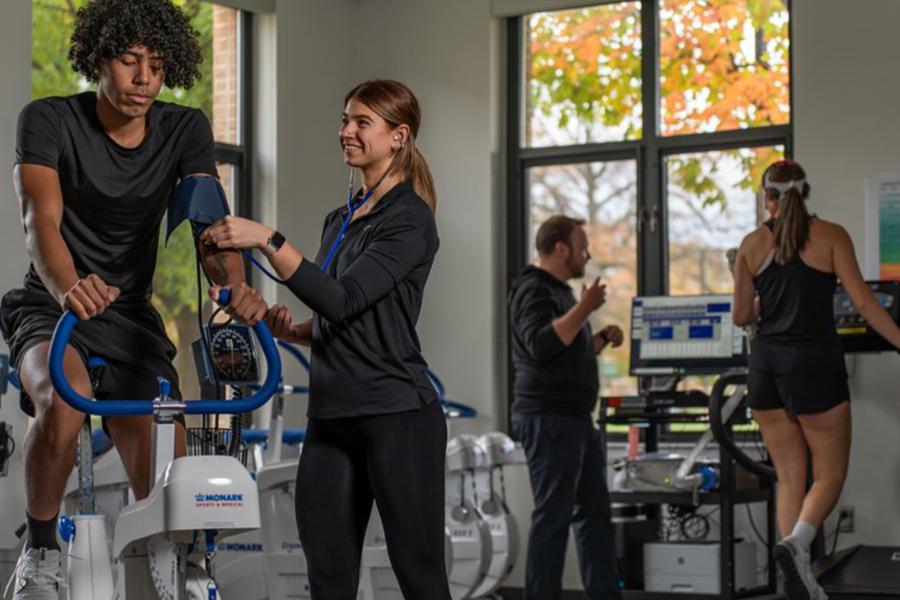
Respiratory Care A.A.S.
The Respiratory Care A.A.S. program prepares students for roles on the healthcare team, focusing on diagnosis, treatment, and management of cardiopulmonary disorders. This selective admissions cohort program combines classroom, lab, and clinical training, and qualifies graduates to take the National Board for Respiratory Care credentialing exams.
Program Information
This is a selective admissions program.
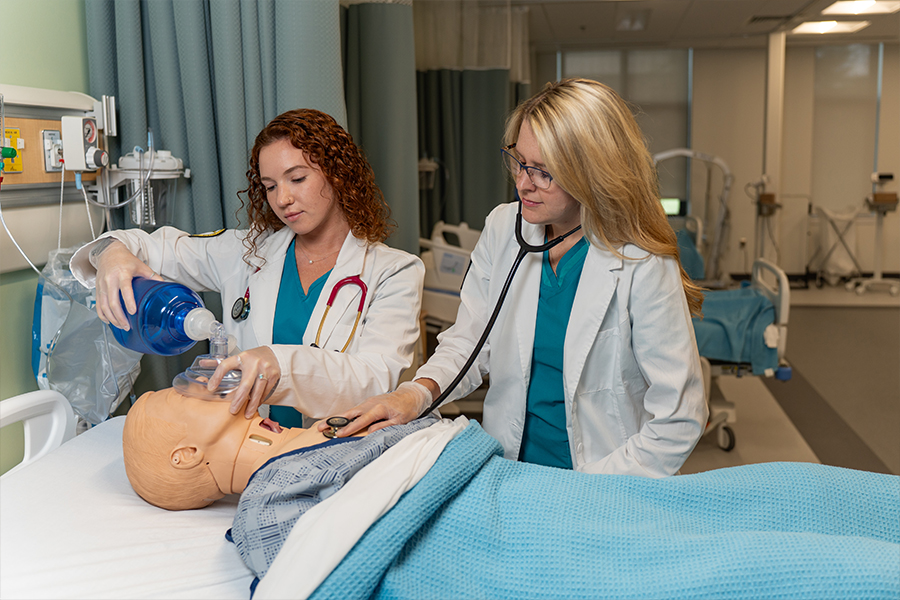
The Respiratory Care A.A.S. prepares students to assume responsible positions as part of the Health Care Team. Focuses on the use of objective scientific data as well as theory to guide students to solve complex problems in the clinical setting. Students receive specialized education in the areas of diagnosis, treatment, management, and preventative care for patients with cardiopulmonary disorders. Respiratory Care students participate in various classroom, laboratory, and clinical experiences. The laboratory experience provides the opportunity for hands on experience in preparation for clinical practice in diverse clinical settings. Upon completion of the program, the student is eligible to sit for The Respiratory Therapy Exam, administered by the National Board for Respiratory Care (NBRC).
Success in the program is defined by your ability to apply what you’ve learned in real-world scenarios. This program ensures that every student achieves the following core competencies:
- Demonstrate diagnostic and therapeutic procedures required to perform respiratory therapist duties entering the profession.
- Perform procedures to maintain the airway, remove secretions, and assure ventilation and tissue oxygenation.
- Perform assessments and modifying therapy based on the patient's response to current therapeutic regimen.
- Demonstrate proficiency within inter-professional teams and communicate effectively with diverse populations.
- Apply problem-solving strategies in patient care settings.
- Demonstrate ethical decision-making skills and professional responsibility.
Success starts with a solid plan. Your program's course sequence is designed to build your skills step-by-step. By following this plan, you ensure you're meeting all program requirements and staying on track.
The Respiratory Care program is a selective admissions program. This pathway is for students who have been accepted into the program only. Students who have not yet been accepted into the program should begin the Health Sciences A.S. pathway and apply to the Respiratory Care program after all selective admissions courses have been completed.
Technical Skills
The following technical standards are essential in order to meet the objectives of the Respiratory Care Program at Frederick Community College. With reasonable accommodations, the student must possess:
- Fine motor skills sufficient to perform skills such as picking up, grasping, manipulating small objects with hands, and writing with a pen or pencil.
- Physical mobility and strength sufficient to move about on a unit and participate in client care.
- Physical stamina sufficient to perform client care for entire length of clinical experience (6-8 hours).
- Auditory ability sufficient for assessment of client health and safety.
- Visual acuity sufficient to distinguish color and see objects up to 20 inches away.
- Reading ability sufficient to understand the written word at a minimum of a tenth grade level.
- Arithmetic competence that would allow the student to read and understand columns and/or writing, tell time, use measuring tools, and add, subtract, multiply and divide.
- Emotional stability sufficient to assume responsibility/accountability for actions, provide client with emotional support, adapt to environmental stress, and monitor own emotions.
- Analytical thinking sufficient to transfer knowledge from one situation to another, problem solve, prioritize tasks, and use long-term and short-term memory.
- Critical thinking ability sufficient to exercise sound judgment through the sequencing of information and the identification of cause and effect relationships.
- Interpersonal skills sufficient to establish rapport with clients and co-workers and respect the rights of others and the differences in clients.
- Communication skills sufficient to teach others, explain procedures, interact with others, and convey information in writing.
Adapted from: Yocum, C.J. (1996). Validation study: Functional abilities for nursing practice. Published by the National Council of State Boards of Nursing.
Health Requirements
Required vaccines and/or tests:
- Tuberculosis: QuantiFERON Blood Test
- Accepted: Negative blood test OR Positive test and clear chest x‐ray within 1 year
- Renewal: Annual
- Tetanus Vaccine, Diphtheria + Pertussis (Tdap) Vaccine
- Accepted: Documentation from provider of vaccine administration
- Renew: Every 10 years
- Measles, Mumps, Rubella (MMR) Vaccine AND Titer
- Accepted: Documentation of two series vaccine administration AND Positive Titer
- Varicella Vaccine AND Titer
- Accepted: Documentation of two series vaccine administration AND Positive Titer
- Hepatitis B Vaccine AND Titer
- Accepted: Documentation of three series vaccine administration AND Positive Titer
- Influenza (Flu) Vaccine
- Accepted: Documentation of administration during the current flu season (September to March)
- Renewal: Annual
- COVID-19 Vaccination
- Accepted: Documentation of administration of two series vaccination and booster
- Physical Examination
- Accepted: Submission of Frederick Community College Respiratory Care Student Health Profile Form completed by provider
- N-95 Mask Fitting
- Accepted: Submission of completed N-95 Form by Frederick Occupational Health or Carroll Occupational Health
- Renewal: Annual
- American Heart Association Basic Life Support
- Accepted: Submission of BLS Card
- Renewal: Every 2 years
- Health Insurance
- Accepted: Proof of active health insurance
Notes:
- All submitted documentation should have the patient/student’s name and date of birth (DOB) clearly stated.
- All titer results must be dated AFTER proof of vaccination.
- Titers must show official lab report/results as positive for acceptance.
- Negative titers represent non-immunity, therefore requiring another administration of the vaccine.
- The Hepatitis B vaccination may be declined should you wish. A signed Hepatitis B Declination Form must be completed and submitted to the Director of Clinical Education. However, you should recognize that working in the medical field puts you at risk, so it is recommended that you complete the series. An “In progress” series will be accepted for clearance with submission of current stage of process and continued CDC vaccination schedule.
- Only the QuantiFERON Blood test will be accepted for the Tb requirement. Skin tests are not accepted.
Other Requirements
- Cardiopulmonary Resuscitation: All students must submit a card proving current CPR certification with American Heart Association. Basic Life Support (this is the only card accepted!). Certification must be maintained and current throughout the academic program.
- Background Checks, Drug Testing and Medical Records: All in-coming students are required to submit to a criminal background check and drug testing in order to attend clinical. Students are responsible for submitting all fees and online paperwork required by the Castle Branch company. Clinical sites may deny a student clinical placement based on the results obtained. Without clinical placement, it is not possible to complete the curriculum requirements. Students must submit results of completed criminal history background checks, drug screening, and medical records three weeks before the first day of the clinical semester. Failure to do so will result in forfeiture of clinical placement. Additionally, students must comply with all clinical site specific requirements as outlined in clinical agreements/memorandum of understanding.
The Respiratory Care Student Handbook will serve as a valuable reference guide for the program.
The Respiratory Care program is accredited by:
The Commission on Accreditation for Respiratory Care (CoARC)
264 Precision Blvd
Telford, TN 37690 USA
coarc.com
817.283.2835
CoARC ID#: 200397
To find more information about how credits may transfer from Frederick Community College to a state four-year institution visit ARTSYS or consult a College advisor.
Frederick Community College has articulation agreements with the following institutions, allowing students a seamless transfer experience. Students who plan to transfer should speak with an advisor or program manager from their chosen transfer institution before selecting elective courses.
Information on Tuition, Fees & Scholarships
- FCC Tuition & Fees
- Scholarships for FCC Students
- Scholarships for Respiratory Care Students
Additional Estimated Expenses
In addition to the tuition and fees charged by the the college, students should plan on the following expenses to complete the program:
- Stethoscope: $70
- Scrub Top & Pants: $60
- Shoes: $50
- Wrist Watch: $30
- Textbooks: $500
- Travel (commuting to and from clinical sites): $2,000
- Vaccinations: $500
- Licensing Exam: $400
Please note: These expenses are estimates and are subject to change.
Goals
To prepare graduates with demonstrated competence in the cognitive (knowledge), psychomotor (skills), and affective (behavior) learning domains of respiratory care practice as performed by registered respiratory therapists (RRTs). - CoARC 2022 Entry into Practice Standards
- Cognitive Skills: Students must demonstrate competence in the cognitive domain by achieving a minimum score of 75% or higher in all respiratory care courses throughout the program, reflecting their foundational knowledge and understanding of respiratory care principles.
- Psychomotor Skills: The following is a list of competencies integrated into the respiratory care program
curriculum. Prior to graduation, students are required to demonstrate proficiency
in each of these skills, ensuring readiness for entry-level practice in the profession.
- Hand Hygiene and Isolation Precautions
- Taking Vital Signs
- Performing a Comprehensive Cardiopulmonary Patient Assessment
- Using a Pressurized Metered-Dose Inhaler (pMDI)
- Using a Dry-Powder Inhaler (DPI)
- Using a Small Volume Nebulizer (SVN)
- Performing Incentive Spirometry (IS)
- Implementing Positive Expiratory Pressure (PEP) Therapy
- Administering Chest Physiotherapy (CPT)
- Performing Sterile Nasotracheal Suctioning
- Sputum Inductions & Collecting Sputum Samples
- Administering Oxygen Therapy with a Nasal Cannula or Mask
- Performing an Arterial Blood Gas (ABG) Puncture
- Providing Manual Ventilation using a Bag-Valve Mask (BVM)
- Administering Oxygen Therapy to a Patient with an Artificial Airway
- Tracheostomy Tube Care and Cleaning
- Administering High Flow Oxygen Therapy
- Initiating Noninvasive Ventilation and Interface Fitting
- Assessing a Noninvasive Ventilator
- Preparing an Invasive Mechanical Ventilator for Use
- Intubation or Intubation Assist
- Initiation of Invasive Mechanical Ventilation
- Assessing an Invasive Mechanical Ventilator
- Endotracheal Tube Care
- Monitoring Cuff Pressures
- Performing Sterile Endotracheal or Tracheal Tube Suctioning
- Monitoring End-Tidal Carbon Dioxide (EtCO2)
- Assessing Weaning Parameters and Performing a Spontaneous
- Breathing Trial (SBT)
- Extubation
- Obtaining Arterial Blood Gas Samples from an Arterial Catheter Line
- Assessing Noninvasive Respiratory Mechanics
- Affective Skills: Students must demonstrate competence in the affective domain by consistently exhibiting professionalism, ethical behavior, and integrity in all aspects of respiratory care practice. This includes successful completion of clinical evaluations and self-assessments, reflecting appropriate attitudes, values, and interpersonal communication skills essential to the profession.
Outcomes
CoARC accredits respiratory therapy education programs in the United States. To achieve this end, it utilizes an outcomes based process. Programmatic outcomes are performance indicators that reflect the extent to which the educational goals of the program are achieved and by which program effectiveness is documented.
Jessica Wirtz, MS, RRT, RRT-ACCS
Program Director
[email protected]
301.846.2528
Rebecca Sonn, BSRT, RRT, RRT-ACCS, NPS, RPFT
Director of Clinical Education
[email protected]
301.846.2516
Nicholas Mariott, MS, RRT
[email protected]

Health Professions Information Sessions
Considering a career in healthcare?
Join us for a healthcare program information session to explore your options! This is the perfect opportunity to learn about our healthcare
career programs and see our state-of-the-art facilities.
Get Started
Program Facts
Start Here. Go Anywhere.
Board Certification
Respiratory Care students participate in various classroom, laboratory, and clinical experiences. The laboratory experience provides the opportunity for hands-on experience in preparation for clinical practice in diverse clinical settings. Upon completion of the program, students are eligible to sit for The Respiratory Therapy Exam, administered by the National Board for Respiratory Care (NBRC).
Connect Your Program to a Career
Explore our Career Communities to see how your program of study translates into real-world opportunities. From specialized resources to professional associations, we’ll help you bridge the gap between the classroom and your career goals.
Get Hired Faster with Handshake
There’s a reason Handshake is the #1 tool for student hiring. Create your profile today to unlock exclusive access to local jobs, internships, and career fairs designed specifically for students like you.
Program Contacts
Faculty
Jessica Wirtz
Program Director
[email protected]
301.846.2528
Admissions
Abby Sines
Select Admissions Coordinator
[email protected]
240.629.7950
Financial Aid
Jefferson Hall
3rd Floor
[email protected]
301.846.2620
Related Programs

Clinical Medical Assistant (CMA)
Learn More
Dental Assisting & Oral Radiography
Learn More